Why Your Resume Keeps Getting Rejected (And How Recruiters Actually Read It)
"Is it the market, or is it my resume?" If you've applied to hundreds of jobs and gotten nothing but rejection emails, you've probably asked yourself this. The honest answer is both — the market is tough, but a poorly built resume makes an already hard situation worse. One recruiter's own numbers: candidates following his approach land roughly one interview for every seven applications. If you're getting one interview after fifty-plus applications, the resume is very likely the bigger problem.
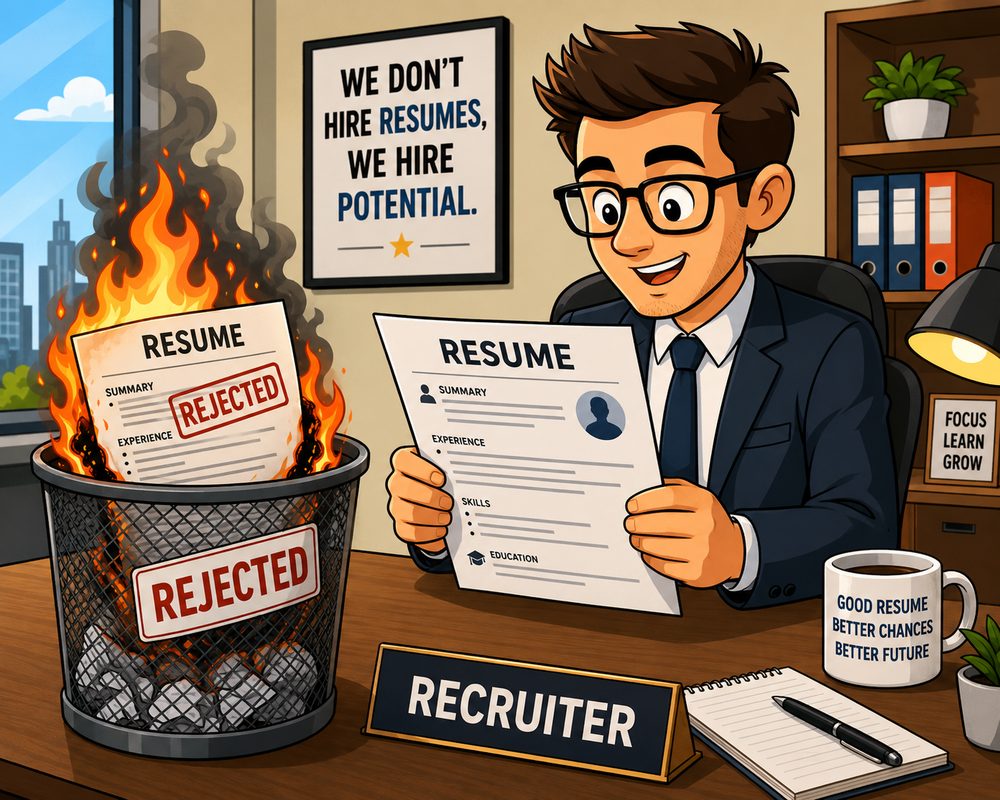
Recruiters don't read your resume — they scan it
A recruiter spends roughly 20 seconds on a resume before deciding whether to keep reading. That means your most important qualifications have to be visible immediately. If a recruiter can't quickly spot the skills they're looking for, the resume gets rejected — even if you actually have those skills. Buried is the same as missing, as far as a 20-second scan is concerned.
Keywords matter more than you think
For a role like Full Stack Software Engineer, recruiters and the ATS behind them are usually scanning for specific, named technologies:
- TypeScript, JavaScript, HTML, CSS
- REST APIs, SQL
- AWS, Azure, or GCP
- React and backend technologies
- Git / GitHub, CI/CD, Agile, DevOps
The lesson worth remembering: don't assume a recruiter or an ATS will infer that TypeScript implies JavaScript, or that JavaScript implies HTML. Write every important technology out explicitly. It feels repetitive to you — it's exactly what the scan is searching for.
Keywords alone aren't enough
Plenty of candidates just list technologies in a Skills section and stop there. That doesn't prove anything — recruiters are looking for qualifications, not a word cloud. A real qualification has four parts:
- What — the technology or skill you used. Example: React, Java, SQL.
- How — how you used it. Example: "Built responsive web applications using React."
- Why — the business value. Reduced manual work, improved performance, increased reliability, improved customer experience.
- Where — internship, company, or personal project.
Miss one of the four, and a recruiter considers the bullet incomplete.
The "hot dogs vs. hamburgers" rule
One of the better analogies from the recruiter's own review process: imagine walking into a restaurant and ordering a hamburger, and the waiter brings you three hot dogs instead, insisting "they're basically the same." They aren't — and that's exactly what happens in a lot of resumes.
Candidates fill bullet points with interesting technical detail a recruiter never asked for — AI agents, Pydantic, Recharts, OpenAI APIs, custom frameworks. Those are extra credit. Recruiters want the basics first: Java, Python, React, SQL, REST APIs, cloud, Git. Call the basics the hamburgers and everything else the hot dogs. Always deliver the hamburger first.
Stop assuming recruiters will infer your skills
A common developer assumption: "If I used Pydantic, recruiters will know I know Python." Wrong — never assume, state it directly.
Weak: "Built authentication using Pydantic."
Strong: "Built Python REST APIs using FastAPI and Pydantic to improve application security and reduce authentication errors."
The second version names Python, REST API, and FastAPI explicitly, and closes with the business value — all four qualification parts in one line, instead of leaving the reader to connect the dots.
Bottom line
None of this is about lying or padding a resume — it's about not making a recruiter guess. Twenty seconds isn't long enough for anyone to infer your skill set from a library name. Spell out the technology, show how you used it, say why it mattered, and say where — every time.
← Back to the blog